
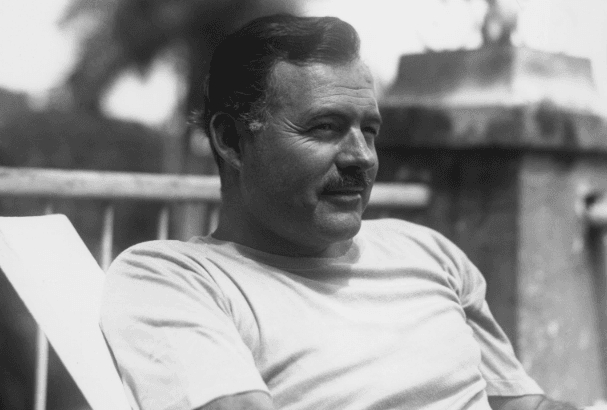
6. Ernest Hemingway
Long before becoming a literary icon, Ernest Hemingway had a brush with death that left a lasting impression on how he viewed life and mortality. During World War I, while serving as an ambulance driver with the Red Cross in Italy, Hemingway was struck by a mortar shell that severely injured his legs. For a brief moment, he was believed to be dead. Unlike many poetic near-death accounts, Hemingway described his experience in blunt, almost mechanical terms.
He later explained that he felt something leave his body, comparing it to pulling a silk handkerchief from a pocket by one corner. There was no dramatic tunnel or light, just a distinct sensation of separation. He felt himself drift away, then suddenly return, as if snapped back into place. There was no fear, panic, or emotional weight attached to the moment. It felt strangely neutral, even ordinary.
This experience reinforced Hemingway’s lifelong fascination with death and danger, themes that later dominated his writing. For him, dying did not feel mystical or terrifying. It felt quiet, brief, and oddly impersonal. His account stands out because of its simplicity, suggesting that death can be experienced without drama, emotion, or symbolism, just a temporary loosening of the connection between body and consciousness.